

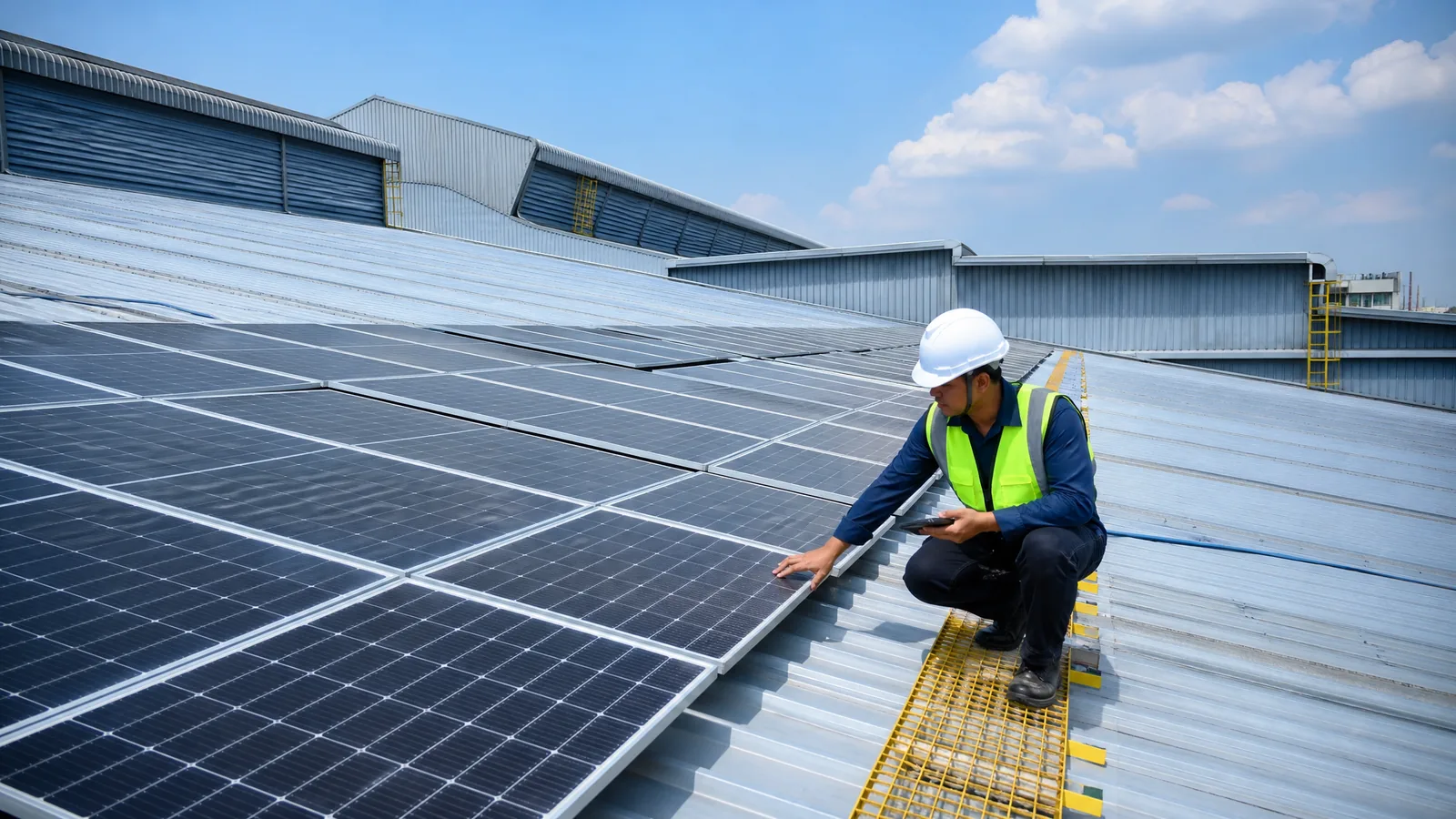
Whether solar rooftop is worth it depends on five main variables: the share of electricity used during daytime, a system size matched to the load, the FT rate trend (which tends to rise), equipment lifespan, and post-installation system care. Winstar estimates payback for factories and commercial buildings at 4-5 years, and for residential homes at 5-7 years, on the condition that daytime electricity use is the primary pattern and the system size is matched to the actual load.
| Usage group | Approximate payback period | Required condition |
|---|---|---|
| Factory / commercial building | 4-5 years | Electricity use is mainly during daytime, and system size matches the load |
| Residential home | 5-7 years | Daytime electricity share is usually lower than for business users |
The 5 variables that decide whether solar rooftop is worth it
Whether solar rooftop is worth it is decided by five variables together: the share of daytime electricity use, a system size matched to the load, the FT rate and its price trend, equipment lifespan, and post-installation system care.
These five variables do not act separately — a system sized larger than the actual load will have surplus electricity sold back to the grid at a price lower than the savings from self-use, while a correctly sized system that is mainly used at night also does not fully benefit from the electricity it generates. Before deciding which group a given site falls into, each variable needs to be understood first.
Once these five variables are understood, there are other perspectives that give a fuller picture of value beyond the payback number alone. Read the full details at 13 Reasons Why Solar Rooftop Is Worth Investing In
How much does daytime electricity share affect value?
The share of electricity used during daytime (06:00-18:00) is the variable with the most weight, because solar panels only generate electricity when there is sunlight. Electricity generated and used immediately saves at the full electricity rate, unlike surplus electricity sold back to the grid, which is priced lower.
Businesses that run machinery or operate storefronts mainly during the day benefit from nearly all the electricity generated, while businesses that mainly use electricity at night, such as operations running late shifts, need to calculate value as a separate case, because electricity generated during the day is not used at the time it is needed.
Why a system size matched to the load matters more than the largest size that fits
The most cost-effective system size is one that generates electricity close to the actual daytime load, not the largest size the roof area can physically fit.
A system larger than the load will have surplus electricity that must be sold back to the grid at a price lower than the savings gained, unnecessarily extending the payback period. Assessing the right size requires looking at actual historical electricity bills and hourly usage patterns, not roof area alone.
How does the FT rate affect the overall value picture?
Each upward adjustment of the FT rate increases the value of electricity generated by the panels, and is a variable that shortens the payback period compared to the initial estimate.
Details on how the FT rate changes and how much it affects payback are explained in the next section of this article.
How do equipment lifespan and a maintenance plan relate to value?
Each piece of equipment in a solar system has a different lifespan, and without planning equipment replacement in advance, unexpected hidden costs will affect the estimated value.
Solar panels and inverters have different warranty periods. Details on how long each component lasts and when it needs replacing are explained in the next section.
Actual payback: why factories differ from residential homes
Factories and commercial buildings pay back faster than residential homes because they use a much higher share of electricity during daytime — Winstar estimates 4-5 years for business users, compared to 5-7 years for residential homes.
This difference does not come from system size or price per kWp, but from how closely actual electricity use aligns with the hours when the panels generate electricity. Business users that run operations during the day therefore use nearly all the electricity generated, unlike households whose peak use is in the evening through nighttime.
For details on how payback differs across industry types, continue reading at Solar for Factories — ROI by 6 Industry Types
Why do factories pay back faster than residential homes?
Most factories run machinery and use the most electricity during the day, which aligns with when solar panels generate electricity, while residential homes usually peak in the evening through nighttime after people return from work, resulting in a lower match between electricity used and generated.
This difference in usage timing is the main reason payback periods differ between the two groups, not differences in system size or price per kWp.
What other factors cause payback to differ between sites even within the same group?
Even within the same business group, payback periods can still differ between sites due to the electricity rate in use, the system size chosen, and roof orientation, which affects actual electricity generation.
Two sites with the same daytime electricity use may still get different payback periods if one site has shading at certain times or chose a system size that does not match its load.
Is the system still worth it after 10 years?
The solar system remains worth it after 10 years, because the solar panels used by Winstar carry a performance warranty as long as 30 years, while the inverter, with a service life of 10 years, is the only component that needs planned replacement on a 10 years cycle — a cost Winstar already includes in the ROI model from the start.
The hidden cost that is often overlooked is the cost of replacing equipment along the way, not the solar panels breaking down or expiring.
The equipment cost figures and the cost of the replacement cycle are already included in the full system pricing calculation. Read the full pricing structure at How Much Does Solar Rooftop Installation Cost — Full 2026 Guide
Does the inverter need replacing once it reaches 10 years?
The inverter has an average service life of 10 years, which is much shorter than the solar panel's lifespan, and is a component that will definitely need planned replacement once it reaches the end of its cycle.
Replacing the inverter once it reaches the end of its service life is a predictable expense, not a risk that appears unexpectedly — this cost is already built into the ROI model at the time payback is calculated, not assessed separately afterward.
How long is the solar panel warranty and how does it affect value?
The solar panels used by Winstar carry a performance warranty of 30 years, a separate component from the inverter with a much longer service life.
This long warranty period means the main cost of the system remains concentrated in the initial investment and the periodic inverter replacement cost only, not repeated panel replacement during the normal service life.
External factors that change value year by year
Solar value is not a fixed number, because external factors such as the periodically rising FT rate and carbon credit measures add extra income to already-installed systems.
These factors are not within the system owner's control, but their direction is fairly clear and positive for value over the long term.
Read details on how the FT rate is calculated at What Is the FT Rate — Why Rising FT Makes Solar Increasingly Worthwhile, and for extra income from carbon reduction, read Carbon Credit + Tax Deductions — Extra Income from Solar
How does a rising FT rate shorten the payback period?
A rising FT rate makes each unit of electricity more expensive, so the electricity generated by the solar panels also becomes more valuable, and the actual payback period will be shorter than the initial estimate, which uses the current FT rate as its baseline.
The estimated payback figure always uses the current FT rate as its baseline. If the FT rate rises in the next cycle, the actual figure will be better than estimated, not worse.
How much does extra income from carbon credits help overall value?
Carbon credits are extra income that comes from the reduction in greenhouse gas emissions achieved by the solar system, which is not included in the main payback figure calculated from electricity savings alone.
Businesses that already have sustainability policies or need to report carbon reduction gain additional benefit from this income channel on top of the electricity savings.
Which businesses pay back fast, and which need further calculation
Businesses that mainly use electricity during the day with a steady load throughout the year pay back fastest, while businesses with irregular loads or future plans to add electrical equipment need additional ROI calculation as a separate case.
Industry type has a major effect on electricity usage patterns. Grouping businesses by usage pattern therefore helps assess value more accurately before calculating actual ROI.
Businesses with their own transport fleet or company vehicles should consider value together with installing an EV charger. Read details at Solar + EV Charger — Installing Together Is More Worthwhile
Why do industries that mainly use electricity during the day pay back fastest?
Industries that run machinery with high electrical load throughout the day usually pay back fastest because the share of electricity generated matches actual use very closely.
This group can often install a large system that fills the whole roof area without much surplus electricity sold back to the grid, because the factory load is high enough to consume nearly all the electricity generated.
Which businesses should consider solar together with an EV charger or other systems?
Businesses with their own transport fleet or company vehicles are a group that should consider installing an EV charger alongside solar, since it helps increase the share of daytime electricity use to better match what the panels generate.
Charging vehicles during the day, when panel output is highest, reduces the amount of electricity that must be sold back to the grid at a low price, improving the overall ROI figure.
Before deciding, what to check before talking to an installer
Before talking to an actual installer, check the current price of the system size needed and have clear criteria for choosing an installer, so the calculated ROI figure does not diverge from the actual price to be paid.
The value figures estimated in this article are an overall framework. The actual price for each site depends on system size, equipment brand, and on-site conditions, which vary.
Asking the right questions of an installer is the last step before signing a contract. Read installer selection criteria at 12 Questions to Ask Before Choosing a Solar Installer
Why check current prices before calculating ROI?
Equipment and installation costs change over time and with system size. Calculating ROI with prices that do not match the current period may cause the estimated payback to diverge from reality.
Price changes usually come from the cost of imported equipment and installation labor at a given time. Referencing the most recently updated prices helps the calculated ROI figure stay closer to reality.
What installer selection criteria make the value figure realistic?
An installer that clearly explains the warranty, maintenance plan, and method for sizing the system to match the load is the factor that gives the calculated ROI figure a better chance of becoming reality, rather than relying on brochure figures alone.
Checking these conditions before signing a contract reduces the risk that the value figure will diverge from what was originally calculated.