

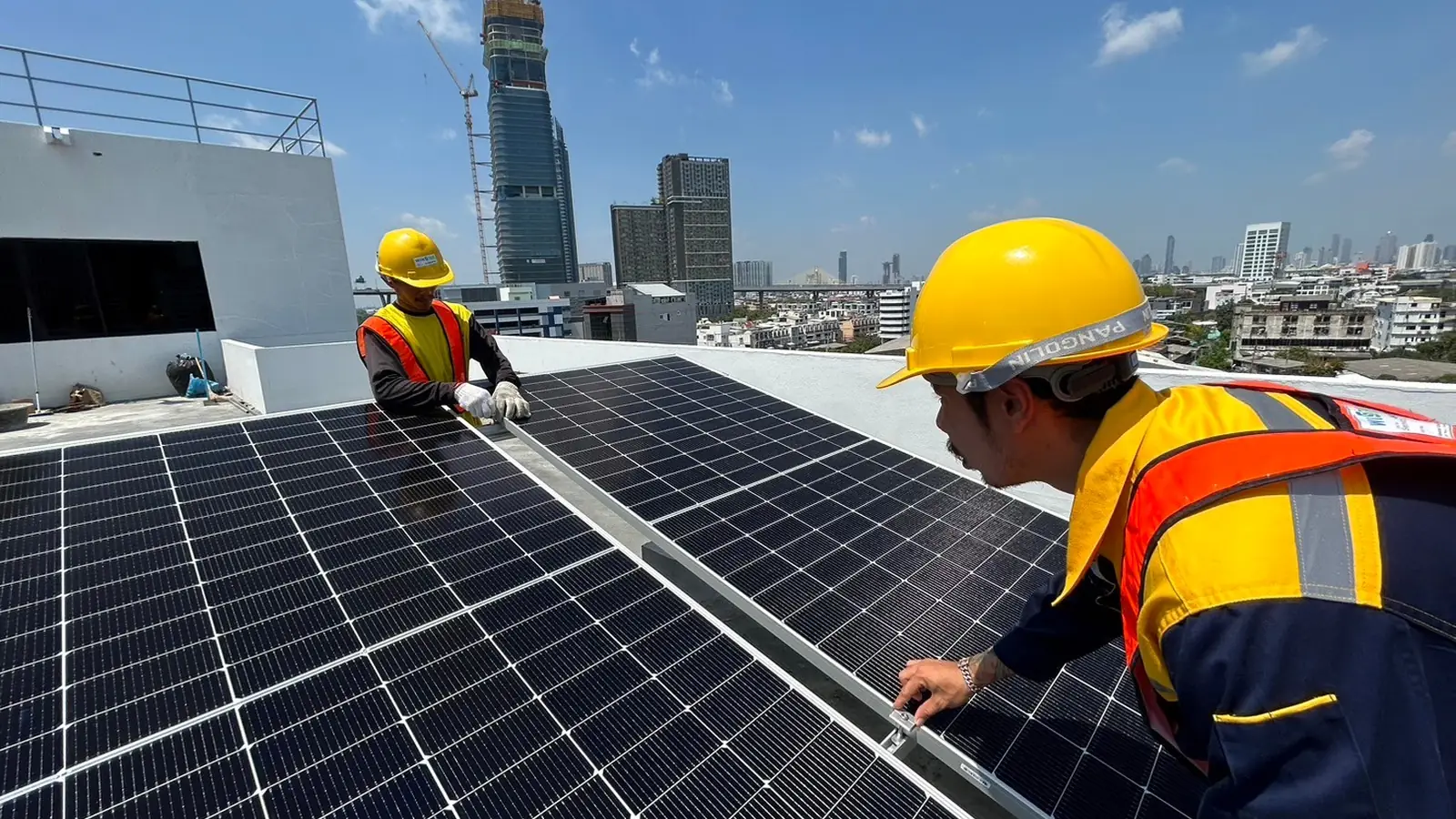
Systems with combined inverter capacity below 1,000 กิโลวัตต์ are exempt from applying for a power generation license, but still must notify the Office of the Energy Regulatory Commission (ERC) using Form SKP.01-1. Installing panels on a roof where the combined weight at any single point does not exceed 20 กิโลกรัมต่อตารางเมตร is not considered a building modification, so no Or.1 building modification permit is required. What remains is grid interconnection with the distribution utility, which every system must file for.
Selling excess power back to the grid is a separate matter from licensing — the 2026 People's Solar Rooftop Power Purchase Program applies only to Type 1 residential electricity users, offering to sell no more than 5 กิโลวัตต์ per meter (Clauses 5 and 6). Factories and juristic entities do not use this route. The program's timeline is set out in Clause 12: results are announced within 30 days, and the contract must be signed within 30 days after the results are announced.
| Matter to file | Where to file | Threshold that triggers filing | Timeframe |
|---|---|---|---|
| Power generation license, or notification (SKP.01-1) | Office of the Energy Regulatory Commission (ERC) | Combined inverter capacity of 1,000 กิโลวัตต์ or more = license required · below that = exempt, but notification still required | Notification: 1–2 daysทำการ · Full license: 30–45 days (engineering team's experience) |
| Building modification permit (Or.1) | Local government authorities, e.g., Subdistrict Administrative Organization (SAO) or municipality | Not required if the combined weight at any single point on the building's roof does not exceed 20 กิโลกรัมต่อตารางเมตร (Ministerial Regulation No. 72) | 30–45 days (engineering team's experience) |
| Controlled power production license (Por Kor 2) | Office of the Energy Regulatory Commission (ERC) | Inverter capacity of 200 กิโลโวลต์แอมแปร์ or more, including backup diesel generators in the count | Not specified in the ERC documents used to write this page |
| Factory operating license (Ror Ngor 4) | Provincial Industry Office | Calculated from horsepower and panel capacity per the catalog, a different basis from the power generation license | Not specified in the ERC documents used to write this page |
| Grid interconnection and selling power to the utility | Distribution utility — MEA 3 จังหวัด · PEA 74 จังหวัด | Every system connected to the distribution grid | People's program: results within 30 days · signing within 30 days (Clause 12) |
| If located in an industrial estate (Kor Nor Or 02/2 · Kor Nor Or 01/2) | Industrial estate office; Por Kor 2 is still filed with the ERC | Factories located within an industrial estate | Not specified in the ERC documents used to write this page |
What Permits Are Needed to Install Solar Rooftop
Three fronts run in parallel: the energy side (power generation license or notification to the Office of the Energy Regulatory Commission), the building side (Or.1 building modification permit from local government authorities), and the utility side (grid interconnection with MEA or PEA). Selling power back is a fourth matter, which is not a permit but participation in a power purchase program.
These three fronts involve different agencies, different thresholds, and none substitutes for the others. A system might not need a power generation license at all, yet still need an Or.1 permit because the roof weight exceeds the threshold.
A common confusion is applying one front's threshold to answer another — for example, seeing that no power generation license is required and concluding that no filing at all is needed. Whether the investment is worthwhile is decided by a different set of variables; read more at Is solar rooftop worth it?
How Are These Three Fronts Separated, and Who Owns Each One
The energy side is owned by the Office of the Energy Regulatory Commission. The building side is owned by the local government authority where the building is located. The utility side is owned by the local distribution utility, which Clause 8 of the ERC announcement also designates as the recipient of power sale applications — not the ERC itself.
Separating ownership matters for timing, because each front starts its own clock from the date its documents are complete, and some permits must be obtained before another can be filed.
Where Does the People's Power Purchase Program Fit Into This Picture
It sits within the utility side, and it is optional, not mandatory — it is a power purchase program available only to Type 1 residential electricity users offering to sell no more than 5 กิโลวัตต์ per meter, at a rate of 2.20 THBต่อkWh, with a contract term of 10 years (ERC announcement, Clauses 5 and 6).
Joining the program does not remove the need to file on the other fronts, and not joining does not mean grid interconnection is unnecessary. A household installing solar purely for self-use still must file for grid interconnection — the only difference is there is no power sale contract.
Do Factory Systems and Residential Systems Follow the Same Path
No — the People's Program is limited to Type 1 residential users, capped at 5 กิโลวัตต์ per meter (Clauses 5 and 6). Factories fall entirely outside this program and have their own additional matters to handle: Ror Ngor 4, Por Kor 2, and industrial estate cases.
What is common is the building side and the utility side, because Ministerial Regulation No. 72 uses the phrase "on the roof of a building" without limiting the type of building, so this page covers those two parts together.
Is a Power Generation License Required, and Where Is the Threshold
The threshold is the combined installed inverter capacity — below 1,000 กิโลวัตต์ is exempt from applying for a license, according to the ERC office's summary document on licenses related to solar power generation, but notification to the ERC office is still required. From this threshold upward, a license must be obtained from the ERC.
A common mistake is reading "exempt" and assuming nothing needs to be done, when the exemption here applies only to obtaining a license, not to the notification requirement.
Another point to know before planning work is that the power generation license must be obtained before construction begins, not applied for later when ready to feed power into the grid.
The unit for this threshold is not yet settled. The ERC office's summary document used for this page states it in kilowatts of inverter capacity, but other documents summarizing the same threshold, and the ERC's own calculation-basis table, state it in kilovolt-amperes. We therefore do not know which unit is correct. This page follows the document currently in hand, so systems close to the threshold should confirm with the ERC office before deciding.
Below 1,000 กิโลวัตต์, No License Is Needed — What Must Be Done Instead
Notification to the ERC office must be filed using Form SKP.01-1, which is a registration, not a license application. From the engineering team's actual work, this notification is approved within 1–2 daysทำการ if the documents are complete.
From the engineering team's experience, a full license application takes 30–45 days, while the notification can be completed in just a few working days. Both figures come from actual work, not statutory timeframes.
Is Capacity Counted from the Panels or the Inverter
It depends on which permit is being discussed. The power generation license and the notification are calculated from the combined Rated Capacity of the inverters in MWAC, excluding backup diesel generators. Ror Ngor 4 is calculated from horsepower and panel capacity per the catalog. Por Kor 2 uses the same basis as the power generation license but includes backup diesel generators in the count.
These three calculation bases mean the same system can give different answers for each permit. A system below the power generation license threshold may already exceed the Por Kor 2 threshold because it has backup diesel, so each permit must be checked separately.
Can Multiple Buildings in the Same Location Have Separate Licenses
Only when all three conditions are met simultaneously: each building has its own independent meter, each meter has combined inverter capacity of 1 เมกะวัตต์ or more, and the systems genuinely operate independently — either not interconnected, or with a Zero Export Controller or Reverse Power Relay keeping the circuit open under normal conditions.
The third condition is verified on site, not from documents. Wiring two buildings together for future use therefore affects how licenses are counted, even if the connection is not yet actually in use.
Do Sites Outside and Inside Industrial Estates File in the Same Place
No, not the same place — outside industrial estates, under Section 48, generation for own use is filed with the local government authority, while generation for sale is filed with the ERC, except for rooftop installations where the building owner must file with the local government authority. Within industrial estates, Forms Kor Nor Or 02/2 and Kor Nor Or 01/2 are filed with the industrial estate office.
The common point is Por Kor 2, which is always filed with the ERC. Ror Ngor 4 for factories outside an industrial estate is filed with the Provincial Industry Office. All of this comes from the ERC's summary document, which does not cite section numbers.
Does Installing Panels on a Roof Require an Or.1 Building Modification Permit
No, if the combined weight at any single point does not exceed 20 กิโลกรัมต่อตารางเมตร on the building's roof, because Ministerial Regulation No. 72 (B.E. 2568 / 2025) specifies that this type of installation is not considered a building modification. If the weight threshold is exceeded, it falls back under the normal definition of modification, and an Or.1 permit must be obtained from the local government authority.
This Ministerial Regulation repeals the text of item (6) of Clause 1 of Ministerial Regulation No. 11 (B.E. 2528 / 1985), as amended by Ministerial Regulation No. 65 (B.E. 2558 / 2015), and replaces it with new text. It was published in the Royal Gazette, Volume 142, Part 76 Kor, dated 19 November 2568 (2025).
This page does not state the date the Ministerial Regulation takes effect, because the source document only provides the Royal Gazette publication date, not the effective-date provision.
What Did Ministerial Regulation No. 72 Change from the Previous Version
It removed two conditions: the one limiting the exemption to residential buildings only, and the one capping the installation area at 160 ตารางเมตร. This leaves a single condition — combined weight at any single point not exceeding 20 กิโลกรัมต่อตารางเมตร on the building's roof.
The result is that non-residential buildings can also qualify for the exemption, and there is no longer an area cap. Factories that previously needed an Or.1 permit because their installation exceeded 160 ตารางเมตร now fall under the weight question instead.
How Is 'Any Single Point' Measured
It is measured at the densest point, not as an average across the entire roof — the Ministerial Regulation's wording states that combined weight at any single point must not exceed 20 กิโลกรัมต่อตารางเมตร, making this a point-specific criterion, not an aggregate criterion for the whole building.
This distinction genuinely changes the design approach, because clustering panels in a single zone may exceed the point-specific threshold even though the roof-wide average has not yet reached it. Calculations must therefore be done zone by zone by an engineer.
What Is Not Covered by This Exemption
The wording of the Ministerial Regulation refers only to installations on the roof of a building, so it does not cover solar carports, which count as new building construction, and does not cover ground-mounted installations. In addition, this exemption applies only to the definition of building modification — all other laws still apply in full.
The last sentence matters more than it appears, because not needing an Or.1 permit does not mean structural calculations or engineer certification can be skipped. The utility itself already requires an engineer's certification letter along with a copy of the engineering license.
Grid Interconnection: Where Do MEA and PEA Actually Differ
The core rules are the same, since they come from the same ERC announcement. What differs is the filing channel and document set for each utility — the MEA area is 3 จังหวัด, namely Bangkok, Nonthaburi, and Samut Prakan; the remaining 74 จังหวัด fall under PEA.
The area count comes from PEA's PPIM manual, page 5. The MEA figure is inferred from that exemption wording, not sourced from MEA's own documents.
This section is the only point on this page where the two utilities are treated separately; the two preceding sections use the same nationwide criteria.
How to Tell Which Area a Home or Factory Falls Under
Check the province where it is located — if in Bangkok, Nonthaburi, or Samut Prakan, it falls under MEA; otherwise it falls under PEA, as PPIM manual page 5 states that PEA's electricity user area covers 74 จังหวัด, excluding those three provinces.
A faster way is to check which utility issued the electricity bill, since the documents, filing channel, and contract signatory are all tied to the local distribution utility.
How to File with PEA, and Can Eligibility Be Self-Checked First
Filing is done online through the PPIM system at ppim.pea.co.th, and eligibility can be self-checked from the electricity bill beforehand. The manual sets out four eligibility conditions: being a Type 1 residential electricity user, still having active electricity service, the applicant's name matching the name on the bill, and the address on the bill matching the current house registration.
Two digits of the code on the electricity bill can be read directly: หลักที่ 1 คือประเภทผู้ใช้ไฟฟ้า หลักที่ 4 คือระดับแรงดัน, where เลข 4 คือ 11–33 กิโลโวลต์ เลข 5 คือต่ำกว่า 400 โวลต์ (PPIM manual, pages 5 and 8). Page 6 states that if the electricity user type is not Type 1, the confirm button to submit a power sale application cannot be pressed. Single-phase and three-phase meters can both sell up to the same 5 กิโลวัตต์ (page 9).
What Documents Must Be Attached for PEA
The PPIM manual specifies the attachments for the online application form in the People's Program: the electricity bill and a copy of the first page of the house registration with a matching address (page 21); a photo of the front of the building where installation takes place (page 24); a single line diagram (page 26); an engineer's certification letter with a copy of a valid engineering license (page 28); and panel and inverter specifications (pages 30 and 32).
The manual also requires that the inverter be registered or tested according to PEA requirements, with the model checkable at smartlist.pea.co.th (pages 27 and 32). For applications filed under power of attorney, an authorization letter and a company certificate issued no more than 6 months prior must be attached (pages 38 to 40). For installations of no more than 10 kWp, the system displays a consent window for PEA to forward the applicant's information to the Revenue Department (page 34); the manual does not explain the conditions of the tax benefit, so this page does not describe it.
What Document Set Does MEA Use
From the engineering team's actual work, the MEA-side grid interconnection document set used by the company consists of a consent letter to join the tax measure program, a power of attorney letter to request connection with MEA, a copy of the meter owner's national ID card and house registration, and the latest month's electricity bill.
A common cause of document rejection is that the ID card and house registration copies must belong to the meter owner, not the resident, and must be certified as true copies with a note stating they are for this purpose only. For additional power sales, a bank account notification letter, a copy of the bankbook's first page, and a copy of the ID of the additional authorized signatory are required. This list is the set the company uses, not an MEA announcement.
What Is the Filing Sequence, and How Long Does Each Step Take
The sequence used in practice is: design first and have an engineer or architect sign off, then file for the Or.1 permit if the threshold requires it. Once the Or.1 permit is obtained, file for grid interconnection with the distribution utility. The power generation license side must be obtained before construction begins. From the engineering team's experience, the Or.1 step takes 30–45 days.
The figures in this section come from two sources that must be kept separate — figures with a clause number (30 days and 30 days) come from Clause 12 of the ERC announcement, while 30–45 days, 1–2 daysทำการ, and 30–45 days come from the engineering team's actual work, not statutory timeframes.
What Must Be Completed Before What
Two conditions mandate the sequence: the power generation license must be obtained before construction, and the Or.1 permit must be obtained before filing for grid interconnection. Meanwhile, notification via Form SKP.01-1 and preparing grid interconnection documents can be done in parallel, since they involve different agencies and different document sets.
Getting the sequence wrong has a cost — if construction has already started and it is then discovered that the project falls under the threshold requiring a power generation license, the work already done is out of sequence from the start.
How Long Does the Licensing Side Take
From the engineering team's experience, filing an Or.1 permit with a Subdistrict Administrative Organization or municipality takes 30–45 days; notification via Form SKP.01-1 is approved within 1–2 daysทำการ if the documents are complete; and a full power generation license application takes 30–45 days.
The Or.1 figure and the full license figure happen to fall in the same range, but they are different matters handled by different agencies. Because they come from actual work, they can be used for planning, but not as a binding commitment.
For the People's Program, What Is the Statutory Timeframe
For Type 1 residential households joining the program, Clause 12 of the ERC announcement sets the application window opening from 1 กรกฎาคม 2569, with results announced within 30 days from the day after receiving a complete application, contract signing within 30 days from the day after results are announced, and grid commercial operation set for ภายในyears 2570.
This timeframe set applies equally to both utilities, since it comes from the same announcement. Where MEA and PEA differ is the filing channel and document set, not the number of days. And because the review order follows the date the application became complete (Clause 10), under an overall target of 500 เมกะวัตต์ (Clause 4), completeness of documents matters more than speed.
What This Page Does Not Yet Cover
Four matters are not yet covered: the fees for each permit, the PEA-side grid interconnection document checklist for cases outside the People's Program, the amount of the grid connection fee and equipment inspection fee, and the date Ministerial Regulation No. 72 takes effect. None of these four items are found in the sources used to write this page.
These gaps are gaps in the source material, not matters omitted because they are unimportant. Every one of them affects cost or the start date of work, so they are noted here rather than left unaddressed.
The last item deserves a brief explanation here, since it is short — the source document used to write this page gives only the publication date of Ministerial Regulation No. 72 in the Royal Gazette as 19 November 2568 (2025), while the date given elsewhere is 17 November 2568 (2025), but does not provide the effective-date provision. This has real consequences for applications filed around that period; seek clarification from the local government authority handling the matter.
How Much Are the Fees for Each Permit
This page cannot answer that, because the ERC's summary document used to write the licensing section does not specify fees for the Or.1 permit, the power generation license, Ror Ngor 4, or Por Kor 2, and the PPIM manual does not address the fees for these permits either.
Ask the agency handling each permit directly: local government authorities for Or.1; the ERC for the power generation license and Por Kor 2; the Provincial Industry Office for Ror Ngor 4.
Is the PEA-Side Grid Interconnection Document Checklist Complete
Only the attachment list for the online application form under the People's Program, per the PPIM manual, is available here. The PEA-side document set for cases outside the People's Program, such as juristic-entity or factory systems, has no source for this page yet.
The complete set this page has from actual work belongs to the MEA side. Applying it to PEA would be a guess, and one that would waste time in the filing round.
How Much Are the Grid Connection Fee and Equipment Inspection Fee
Clause 11 of the ERC announcement states that applicants who pass review must contact the utility to have their meter changed to a digital electricity meter if the existing one does not support it, and must pay a grid connection fee and an equipment inspection fee, but this clause does not specify the amount or a timeframe.
This cost arises after passing review, so it should be asked about with the utility before deciding. The price of the system itself is a separate matter — see price ranges by size at How much does solar rooftop installation cost?