

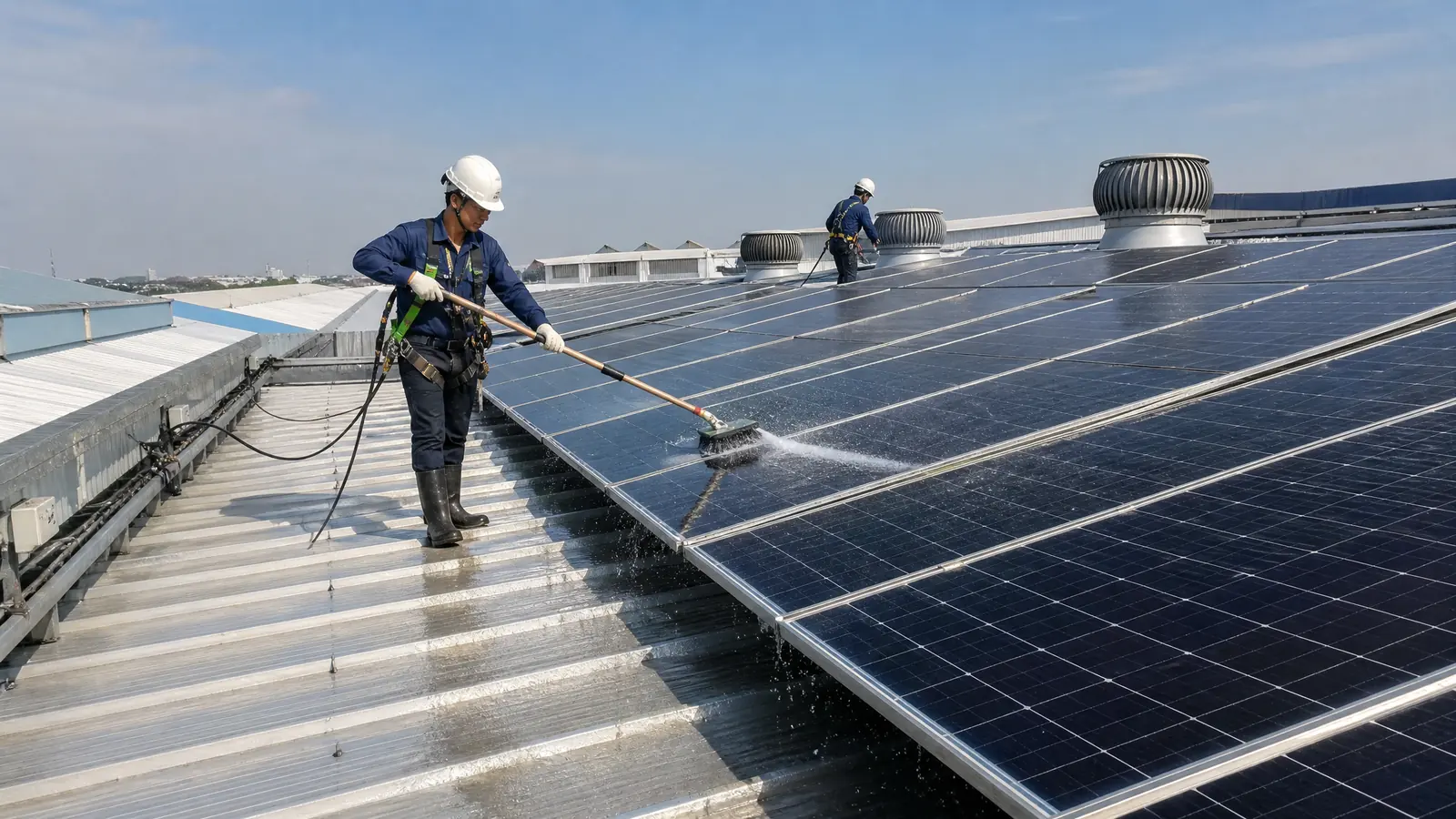
Maintaining a solar rooftop system after installation means standard-contract PM visits 2 timesต่อyears (some contracts adjust to once a year with a longer contract term). Panels degrade about 1 % in the first year, then continue degrading at 0.35 % per year, under a panel power output warranty condition of 30 years. The inverter has an average service life of only 10 years, much shorter than the panels, so system owners should set aside budget for inverter replacement from day one of installation.
All figures on this page come from a group of sites actually connected to Winstar's monitoring system, not theoretical values from specifications alone, so they reflect real post-installation behavior rather than warranty numbers on paper.
| Item | Average value / duration |
|---|---|
| Maintenance (PM) visit cycle | 2 timesต่อyears per standard contract |
| First-year panel degradation | 1 % |
| Annual panel degradation thereafter | 0.35 % per year |
| Panel power output warranty | 30 years |
| Inverter average service life | 10 years |
| Inverter warranty | 10 years |
| Installation workmanship warranty | 2 years |
After installation, how many times a year does the system need maintenance visits?
Winstar's standard maintenance contract includes visits 2 timesต่อyears. Some customers request a once-a-year adjustment in exchange for a longer contract term, or request an extended interval. Among the group of sites connected to the monitoring system, overall system status is reported as normal at 97 %.
Maintenance visits are not just dusting off the panels — they also include checking wiring connection points, the condition of panel mounts on the roof structure, and inverter readings, in order to catch abnormal signals before they affect actual power output.
What does Preventive Maintenance (PM) check?
Each PM round covers checking the condition of panels, wiring, connection points, and inverter readings, in order to catch abnormalities before they affect power output.
Technicians walk through and check for loose or corroded connection points, compare voltage and current readings from the inverter against the system's normal values, and inspect the external condition of panels for cracks or abnormal buildup of dirt.
Overall system health across the monitored site group
The latest monitoring system data shows that connected sites report normal status at 97 %, reflecting that scheduled PM visits help catch problems before they escalate within this group of sites.
This figure covers only sites connected to Winstar's monitoring system, not an average across all customers, so it should be used as an illustration rather than a guaranteed figure.
What hours does the system produce the most power, and how to plan usage around that period?
Based on hourly data from the group of sites connected to the monitoring system, the 84 % 9:00 AM–4:00 PM window accounts for of total daily output, meaning that scheduling factory power use to match this window helps reduce reliance on grid electricity the most.
This figure comes from a short data window of the monitored site group, not a full-year average, since sunlight yields differ by season. However, the pattern of output concentrating around midday can still serve as a planning guide.
Why is output highest around midday?
Around midday, sunlight strikes the panels at the most perpendicular angle, so the amount of light hitting the panel area is higher than in the early morning or late afternoon.
The changing angle of incidence of sunlight throughout the day is the main factor that produces an output curve peaking at midday and declining on both sides.
How to apply this data to factory load planning
Equipment with high power draw should be scheduled to run during midday hours, to directly use the power produced instead of purchasing additional electricity from the grid.
Factories with flexible production line timing can shift high-energy tasks, such as compressors or cooling equipment, to midday to align with the system's peak output period.
How much do panels degrade per year, and how many years is the power output warranty?
Solar panels degrade by about 1 % in the first year, then continue degrading at 0.35 % per year, under a power output warranty condition covering 30 years.
This degradation figure is a standard value per manufacturer specification, used to calculate the power output warranty line. This means that by the end of the warranty period, the panels still produce power no lower than the percentage stated in the contract — it does not mean production stops immediately when the warranty ends.
How much do panels degrade in the first year?
In the first year of use, panels degrade by about 1 %, slightly higher than subsequent years, which is a natural characteristic of solar cells during the early period of use.
This first-year degradation value is predetermined in the manufacturer's specification — it is not a sign that the panel has a problem.
How much do panels degrade per year after that?
After the first year, panels continue degrading at a rate of 0.35 % per year throughout the warranty period.
This rate is fairly constant each year, making it possible to estimate the remaining power output in any given year in advance, for long-term financial planning of the system.
How many years does the power output warranty cover?
The panel power output warranty covers 30 years, the period during which the manufacturer confirms that power output will not fall below the specified threshold.
This period is much longer than the inverter warranty and the installation warranty, so it is often used as the benchmark for the whole system's lifespan when calculating cost-effectiveness.
Inverters — actual service life vs. when replacement is needed
Inverters have an average service life of about 10 years, while the standard warranty period is 10 years, so system owners should set aside budget for at least one inverter replacement over the system's lifetime.
The inverter is the hardest-working component in the system because it converts power continuously whenever there is sunlight, so it degrades much faster than the panels. Setting aside budget in advance prevents this from becoming an unexpected large expense.
Average service life vs. warranty period
The inverter's average service life is 10 years, close to the warranty period of 10 years, so it often reaches the end of its service life around the same time the warranty ends.
This closeness is not a coincidence — manufacturers set the warranty period to align with the projected actual service life.
Signs that indicate an inverter needs replacement
Signs commonly seen before an inverter fails include abnormally reduced conversion efficiency, unusual noise or heat, or repeated error codes on the display.
If these signs appear near the end of the average service life, plan for replacement in advance rather than waiting for complete failure before sourcing a new one.
How much do shading and dirt buildup affect output?
Shading covering 5 % or more of the panel area begins to significantly affect output, which is the threshold used to determine where tree branches should be trimmed or obstructions removed before installation.
Shading affects output more than general dust buildup, because panels within the same string are electrically connected. When some cells are shaded, the power output of the whole string may drop by more than the actual proportion of area shaded.
The shading threshold that begins affecting production
When 5 % or more of the panel area is shaded, output from that panel string begins dropping by a proportion greater than the actual shaded area.
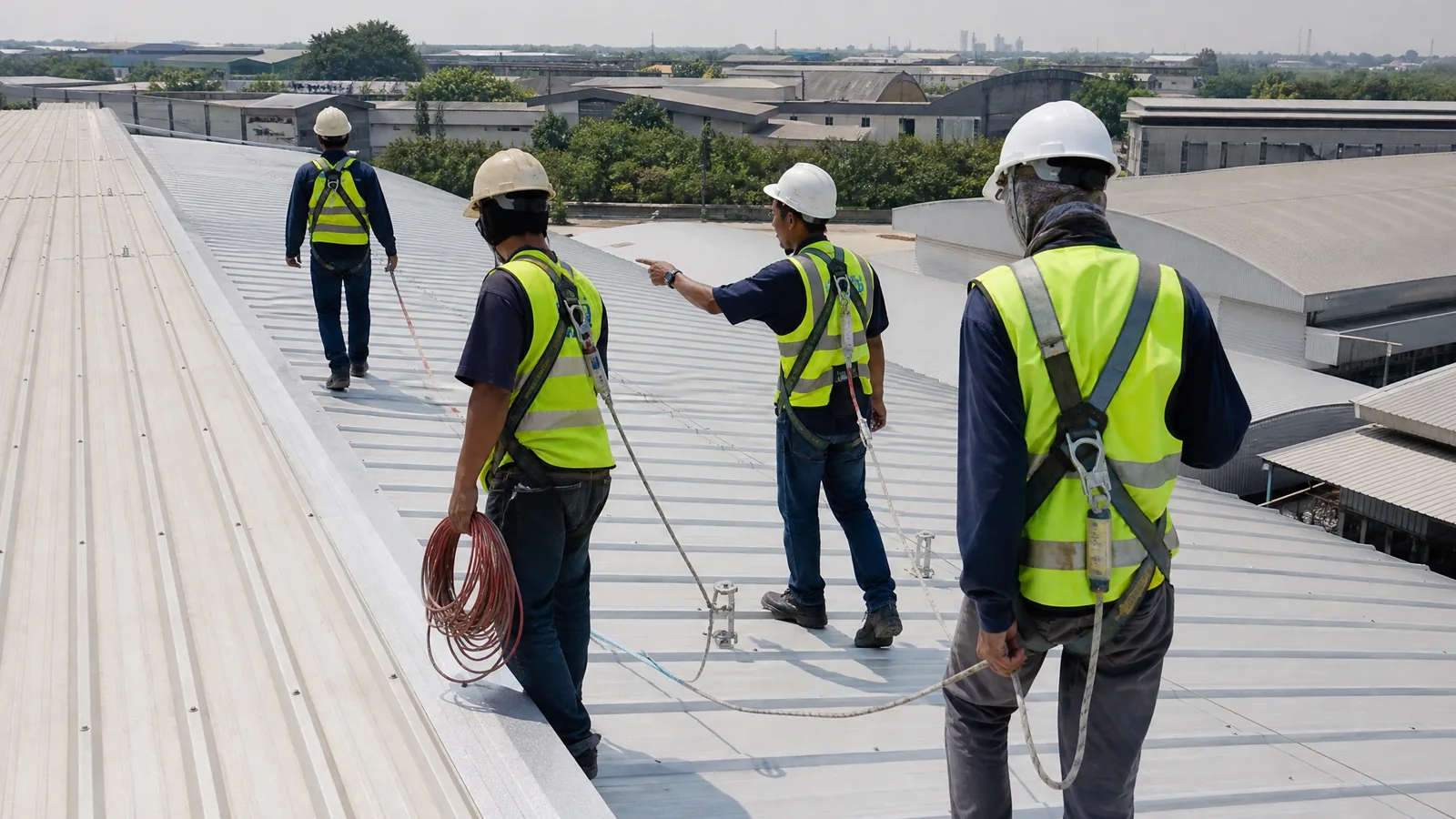
The on-site survey team checks the position of trees, signage, or structures around the roof before designing panel placement, to avoid spots with shading exceeding this threshold during key hours of the day.
Recommended cleaning frequency
The appropriate cleaning frequency depends on the environment around the factory — for example, areas near dusty roads or where birds frequently perch accumulate buildup faster than typical sites.
A practical approach is to have the PM team assess on-site conditions at every visit, then adjust cleaning frequency based on actual buildup found, rather than following a fixed schedule.
How much weight and area does the roof structure need to accommodate long-term?
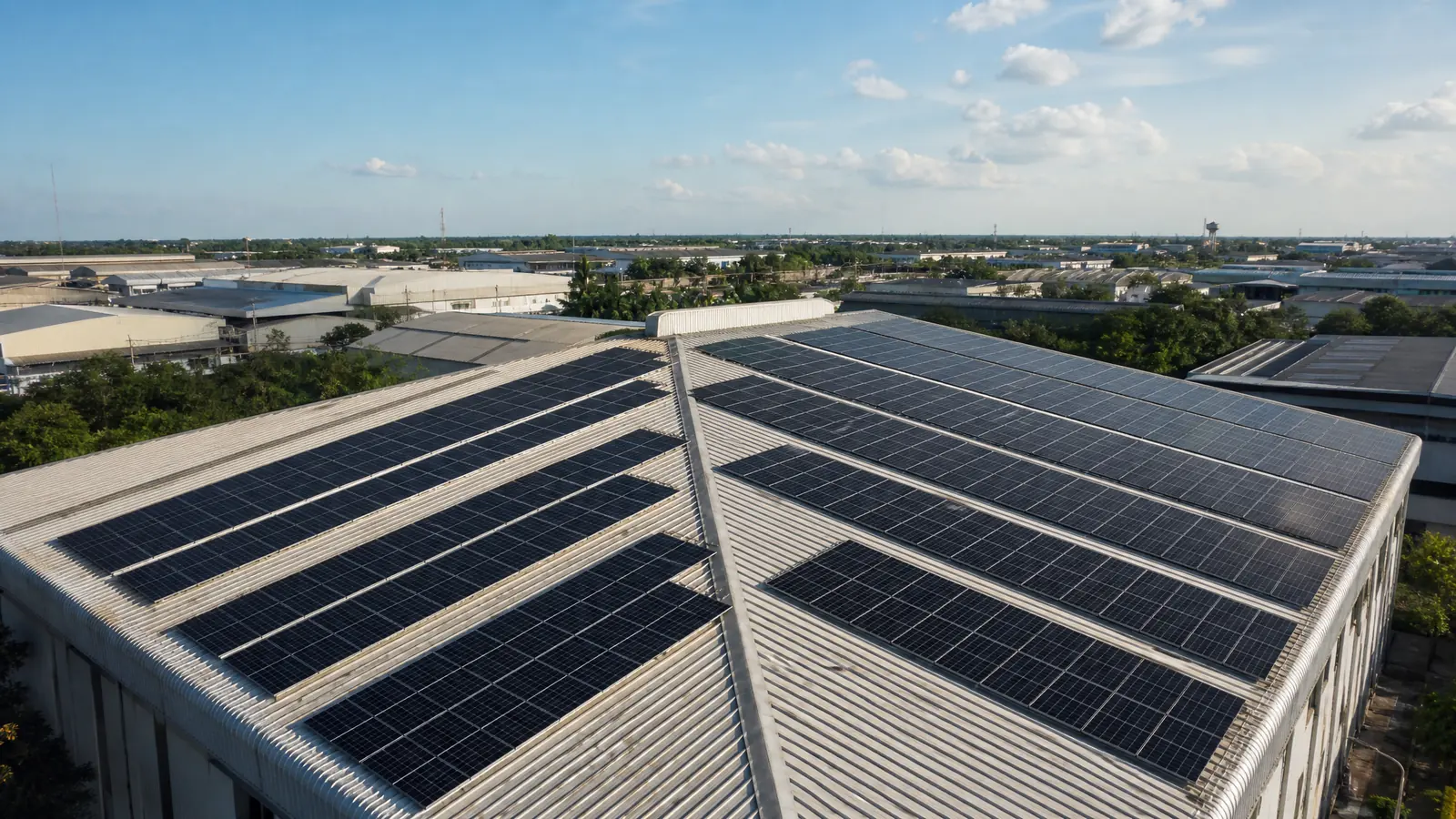
The roof structure must be able to support an additional load of at least 30 kg/m² and must have usable area of about 430 m² ต่อกำลังผลิต 100 kWp, to accommodate future system expansion or reassessment of the existing structure.
These two criteria are not used only at initial installation — they also serve as the benchmark any time a factory considers expanding capacity, since the existing structure may not be able to support as much as it did at the original design stage.
Minimum weight the roof must support
The roof structure must be able to support an additional minimum load of 30 kg/m² in order to install a solar system without requiring additional structural reinforcement.
This figure is compared against the original construction drawings or an engineer's assessment. If the structure supports less than this, reinforcement must be considered before installation.
Roof area required per 100 kWp of capacity
Installing 100 kWp of capacity requires roof area of about 430 m² ต่อกำลังผลิต 100 kWp, a figure used for a rough assessment of how much capacity the existing roof can accommodate.
Factory owners planning future capacity expansion should reserve area according to this ratio from the time the first system is designed.
What does the warranty cover, and who is responsible when a problem occurs?
The solar system has three main, clearly separated warranties: a panel power output warranty covering 30 years, an inverter warranty covering 10 years, and an installation workmanship warranty covering 2 years.
Separating these three warranties matters because when a problem occurs, it is important to know whose responsibility it falls under — for example, a problem caused by loose installation differs from a problem caused by the panel or inverter itself.
Solar panel warranty
The solar panel warranty covers power output for 30 years, the longest of the three, because panels have the fewest moving parts.
If power output falls below the threshold stated in the contract before the warranty ends, the manufacturer is responsible for compensation or panel replacement according to the stated conditions.
Inverter warranty
The inverter warranty covers 10 years, which is close to the average service life mentioned earlier.
Once this period ends and a problem occurs, the system owner is responsible for replacement or repair costs, so budget should be planned in advance as discussed in the previous section.
Installation workmanship warranty
The installation workmanship warranty covers 2 years, covering problems caused by installation quality, such as leaks at mounting points or poorly routed wiring.
This warranty period is shorter than the other two because it is the period during which installation-related problems tend to appear most clearly. If this period passes without issues, the risk from installation work drops significantly.
Want to go deeper on each topic? What to read next
Each topic covered above has a dedicated article that goes into more detail. Choose based on the topic most relevant to the decision at hand.
How the system works, and whether battery backup can be added — How a Solar Roof System Works · Solar + Battery Backup
Selecting equipment yourself — Types of Inverters and How to Choose · Types of Solar Panels and Their Differences · What Is a Tier 1 Panel · How Half-cut Cells Are Better · P-type vs N-type Panels: What's the Difference
Haven't started installation yet, want to know the steps and permits — Solar Installation Steps and Permits